
Table of Contents
Is my child overly active or am I overthinking? I know and understand you really don’t want to attach a name to the condition. We all do, because why children are born happy active and hold loads of energy right? That every parent’s intuitions whenever they notice too much energy, inattentiveness and impulsive behaviors. But guess what, it’s okay, it’s not that bad we can sail through it and we are strong. So let’s attach a name, learn, love and practice great parenting to this little humans.
Attention Deficit Hyperactivity Disorder or ADHD/ Attention Deficit Disorder is the condition at hand that affects many children worldwide. ADHD affect the brain functionality that failing in the neurodevelopmental disorders. The condition is starts in childhood and proceeds to adulthood.
ADHD is visible in different daily life aspects like trouble controlling impulsive behaviors, inattentiveness or paying attention being overly active/hyperactive. Children diagnosed with Attention Deficit Hyperactivity Disorder tend to act on things without thinking much of the consequences. However, this doesn’t mean they don’t focus on anything. No, children or individuals with ADHD will concentrate on activities they love and value.
Types of Attention Deficit Hyperactivity Disorder (ADHD)
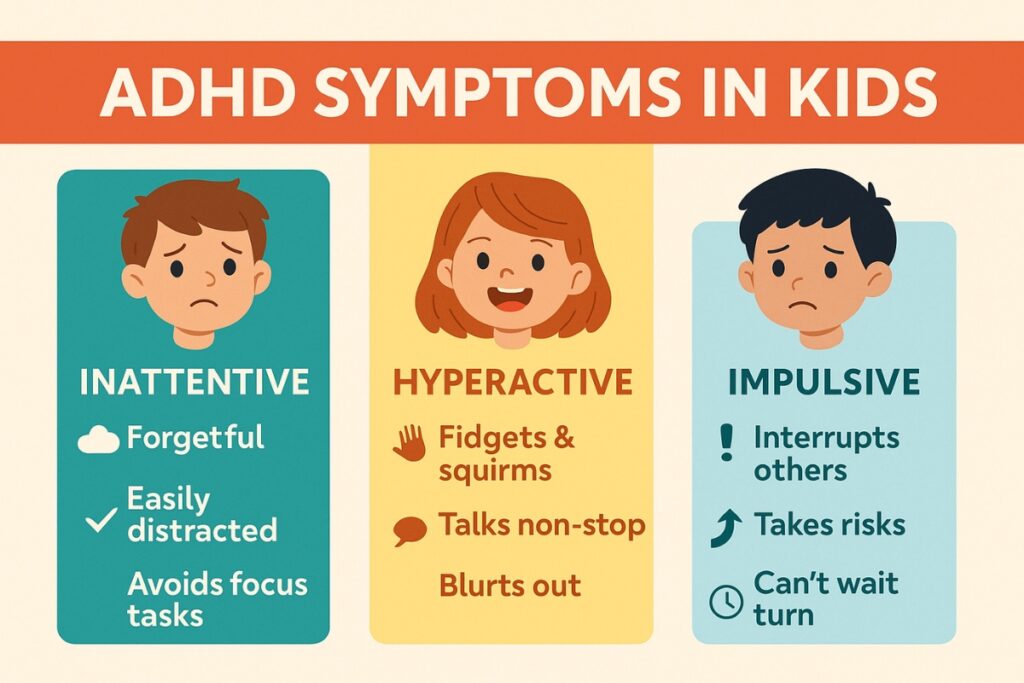
ADHD is concealed in three types depending on the symptoms. A child can show particular signs more than others thus falling at a specific type or ADHD category.
- Predominately Inattentive or inattentive ADHD
This is the core type that holds significant symptoms such as trouble focusing, staying still or concentrating. The user has trouble in organizing or getting orderly for long.
- Hyperactive/impulsive
The hyperactive type is focused on the user being too active or having too much energy. This might cause disruptive behavior while doing different activities. The impulsive part means the child or adult acts without thinking of the results.
- Combined ADHD
The combined ADHD is a mixture of hyperactivity, impulsive and inattentive. It’s where the child falls in both categories means the two extremes of Attention Deficit Hyperactivity Disorder.
Visible symptoms of Attention Deficit Hyperactivity Disorder
Inattention ADHD (Attention Deficit Hyperactivity Disorder)
Children with inattentive ADHD possess the following symptoms:
- The child doesn’t show much interest or has hard time listening.
- Daydreaming and lack of attention.
- They are easily distracted from their activities.
- The child or individual make careless mistake and they are unbothered.
- Disorganized.
- They tend to loss important things.
- Forgetful even on important things.
- The individual or child avoids task that require mental effort.
Hyperactivity and impulsive ADHD
A child with Hyperactivity and impulsive ADHD will present the following symptoms
- The child or adult will be constantly on motion.
- One can’t stay still or seated in one place.
- They repeatedly squirm and fidget.
- Very talk active.
- They always jump, run, climb on things even in odd places.
- The child can play quietly.
- Acting without thinking or speaking without thinking.
- No patient to take turns. They also don’t have patience to wait for things.
- Kids and adults with ADHD answer are hasty to answer before the question.
- Always or frequently interrupts others.
Is it typical development or is it ADHD?
ADHD can be confused with the usual developmental stages. Children are always hyperactive and impulsive especially during their toddler stages. The attention span is also short and they tend to be all over and eager to talk and interrupt. Amazingly, attention span issue can be noticed in adults and teenagers. We all put out full attention on what we like/love right?
With the knowledge that children can be hyperactive and very energetic. This shouldn't automatically classify the person or child to be with Attention Deficit Hyperactivity Disorder. Note, a child can be overly active or inattentive in school but very calm at home and vice versa. Ensure to get the correct diagnosis before labelling a child/teenager or adult ADHD. The symptoms might be as a result of stress, boredom or certain difficulty in life.
When to involve a doctor/pediatrician

Once you observe the signs it’s wise to visit a pediatrician or a doctor for further examination. Teachers or your child care giver should be part of the journey since they spend most of the time with the child. You can have them create a report of the child’s behaviors and present it at the doctor’s appointment. For more observation a good and qualified doctor should ask questions such as:
- How is your child performing in school?
- Are there any learning difficulties observed by the teachers or you as the parent/guardian?
- How do they behave while playing with others?
- What is their attention span while conducting different activities?
- What are their interests and how do they respond attention wise?
- What are your concerns as a parent?
These are some of the relevant question a pediatrician should ask as they continue with extensive examination.
Treatment of Attention Deficit Hyperactivity Disorder
After the diagnosis parents/guardians can embark on the treatment journey. However, there is no specific treatment or cure for ADHD. However, there are multiple approaches to handle each child’s needs.
The treatment focuses on:
- Long term management: this helps in molding behavior and monitoring their activities for positive outcome.
- More education on ADHD: the treatment helps involved parties learn more on Attention Deficit Disorder. Parents learn how to handle the situation while educators learn how to teach and give different exercises. This helps with attention and give a sense of belonging. More education allows the doctors to understand the medication and new ways to administer treatment.
Note, Attention Deficit Disorder can be highly mistaken to rudeness or disobedience. More awareness should be create to help society and family understand the condition. This will remove the misunderstanding and help people love, direct and live well with the children.
What should a parent do?
What should a parent do in matters ADHD? That quite rough, it’s not easy it’s overwhelming but every parent can try. Parents/guardians and family can start by educating those people who are around the child. The teachers, nanny, friends and family.
Parents need to learn more about the condition to ensure you have better understanding of every tiny detail. This allows you to be equipped when educating others. Another major thing a parent should do is take it easy. You didn’t do anything wrong. You are the best parent and your child will grow up and become the best.
Love yourself, avoid negativity, rest, reset, cry if need be and continue. From my experience not everyone, okay people will think you are just a defensive parent. You don’t want to discipline your child and all that. In this journey and every disorder or disability journey you need to have shock absorbers. It will not be easy but you can make it easy for you and your child.
What can you do for your child?
First, you have realized Attention Deficit Hyperactivity Disorder treatment are more of behavior observation or mental physical thing. Not like the child will have a pill every day to make them attentive or less impulsive (in most cases). What you can do for your child is as follows:
- Create interesting activities that will help with attention.
- Be realistic and don’t compare your child with others.
- Rate the behaviors and see at what extremes. Like have a rating scale and see is it normal, abnormal, average and such. This will help now what you can teach by either rewarding good behavior or punish.
- Check whether it’s an extreme ADHD that may require some mediation to keep them calm or reduce anxiety. Note, Some kids might have more than one condition.
- Positivity and encouragement should be your biggest strategy. Always encourage any good work.
- Have a schedule a routine that should be strictly followed. This will help the brain learn what is important and when it should be done.
- Always have reminders visible planners that will guide your child.
- Parents need to set realistic timer for every activity.
Long term plan

Consistency in the plan is key. Parents need to keep a certain routine to ensure the child understand what is expected of them. Always monitor the child behavior and keep some recording to help evaluate the results after given period. This is a lifetime plan which will help your child turn to a responsible teen and adult.
There are several not approved not recommended or no scientific backing methods that parents consider. Some families reduce on sugar consumptions, use therapies like Kinesiology have minerals and supplements. However, this are not recommended and one must ask their qualified pediatrician. Never administer any drug to your child trying to curb any symptoms. Parents can check on the recommended stimulants (immediate release and extended release medications).
ADHD causes
- Genetics
Attention Deficit Hyperactivity Disorder is or can be genetically produced. A child is likely to have some genes that cause the brain to develop differently. The condition is passed from biological family. Suppose a child has ADHD it’s likely the parents or a family member has the condition. With Research it’s believe that a child or person with Attention Deficit Disorder their brain’s frontal lobe is created with the inability of direct attention. The individual can’t focus on things they don’t find interest in. People without the condition use directed attention to conduct task and solve problems. This what makes ADHD different from others?
The best part of children or people with ADHD is that they have automatic attention. This is a type of attention used in focusing on things one is interested in. Once they recognize what they like they put their full energy. This is called hyper focus. That why they are very good at particular hobbies which other can't achieve.
- Environmental factors
Though this is slightly connected to genes. It’s more amplified to users whose genes are ADHD aligned and they are exposed to different environment factors such as:
- Drugs and toxic substances.
- Birth risks like low birth weight.
- Preterm births
Common complications of the condition
With the condition comes some setbacks which are experienced by both child and parents/guardians. The issues are complicated if one doesn’t get proper diagnosis and maybe the society and family has less or no knowledge about ADHD.
- The child’s self-esteem is low since they are always scolded or unwanted.
- They don’t perform well in school.
- Bad social life since they are bullied or not wanted by friends.
- Most kids turn to substance abuse to ease the shame and loneliness.
- Majority of people with condition can keep a job.
Conclusion
Big question is ADHD a disability? Yes and falls under neurodevelopmental disability known by various authoritative bodies like ADA and IDEA. However, it’s not a limitation but a condition that you can live and achieve in life. Parents need to embrace the journey regardless of the challenges and win.